Expert commercial and residential plumbing for Boston's Financial District — historic office-to-loft conversions, high-rise commercial towers, and luxury condos on State Street, Congress Street, and Franklin Street. Sophisticated clients deserve sophisticated service.
Call (888) 861-3658 — Available NowCommercial expertise, residential precision, and 24/7 availability for the heart of New England's business center.
The Financial District of Boston — ZIP code 02110, centered on the State Street, Congress Street, and Franklin Street corridor — is the commercial and financial nerve center of New England. On any given weekday, tens of thousands of bankers, lawyers, financial professionals, and support staff fill the glass towers and converted masonry buildings that line these streets. After business hours, a growing residential population of young professionals and urban lifestyle seekers occupies the luxury loft condominiums that have been carved from the same buildings that once housed 20th-century offices and financial trading floors. This mix of daytime commercial intensity and growing residential permanence creates a plumbing service demand that is unlike anything found in purely residential or purely commercial Boston neighborhoods — and it requires a plumbing contractor with genuine expertise in both commercial building systems and high-end residential plumbing, combined with the urban access capability to operate effectively in one of the most vehicle-hostile environments in New England.
Financial District Plumbing Pros was built specifically for this environment. We understand the multi-tenant commercial building systems that serve the neighborhood's historic granite and brick office towers — the high-pressure cold water distribution systems with floor-by-floor pressure reduction, the steam and hot water heating systems that run through shared mechanical chases, the domestic hot water recirculation systems sized for hundreds of occupants, and the commercial restroom plumbing that must withstand the daily demand of thousands of office workers. We understand the conversion challenges of former office buildings now serving as luxury residential: the original building drain and supply infrastructure designed for commercial occupancy being repurposed for residential use with different flow patterns, different drain locations, and different water heating demands. And we understand what Boston's building management companies and property managers — who authorize and oversee maintenance work in the Financial District's buildings — expect from a professional plumbing contractor: clear scopes of work, accurate time estimates, coordinated scheduling that minimizes disruption to tenants, and documentation of completed work that protects the building owner's regulatory compliance position.
The Financial District's plumbing infrastructure adds another dimension of complexity: the neighborhood sits on filled land developed in the 19th and early 20th centuries, with a layer of original clay and cast-iron sewer infrastructure beneath streets that have been repeatedly excavated, repaved, and modified over a century and a half of urban development. The BWSC's infrastructure maps of 02110 show a complex underground network of large-diameter combined sewers, multiple water mains at different ages and materials, and the remnants of original utility corridors that once served now-demolished buildings. Navigating this infrastructure for any project that involves connection to or modification of city utilities requires the BWSC permit expertise and street-access coordination capability that defines professional commercial plumbing work in downtown Boston. We manage all of this on behalf of our clients, from permit application through final inspection sign-off.
24/7 emergency response for Financial District commercial buildings, luxury lofts, and office towers. Building management company liaison and coordinated emergency protocols.
Learn More →Commercial floor drain and stack cleaning, restaurant district drain service, and loft condo drain maintenance for the Financial District's mixed-use building inventory.
Learn More →Commercial water heater service for office buildings and hotels, residential water heater repair for Financial District luxury lofts. All brands and configurations.
Learn More →Tankless and commercial water heater installation for converted loft buildings and commercial suites. Full Boston building permit service — ISD and BWSC covered.
Learn More →Pipe repair in converted 20th-century office buildings and high-rise commercial towers. Historic masonry building pipe routing and modern high-rise supply system service.
Learn More →Electronic and thermal leak detection for Financial District buildings — from basement mechanical room leaks in historic bank buildings to high-floor supply leaks in glass towers.
Learn More →Commercial restroom plumbing for office buildings, luxury bathroom finishing for loft condos, and ADA-compliant fixture installation for building upgrades.
Learn More →Commercial kitchen drain service for Financial District restaurants, and residential kitchen installation for luxury loft conversions with high-end appliance requirements.
Learn More →Trenchless lining and traditional repair for Financial District sewer laterals. BWSC permit management and street excavation coordination for downtown Boston projects.
Learn More →BWSC water main connections and lead service pipe replacement for pre-war Financial District buildings. Backflow prevention device installation and testing for commercial properties.
Learn More →Commercial restroom toilet repair for multi-tenant office buildings and retail spaces. Residential toilet service for Financial District luxury loft condominiums.
Learn More →Premium water filtration for Financial District luxury lofts and office amenity spaces. MWRA chloramine treatment solutions and lead reduction for Boston's urban core.
Learn More →The Financial District's buildings range from 6-story early 20th-century masonry commercial buildings on Franklin Street to 40-story glass towers on Congress Street, and the plumbing requirements of these buildings scale in complexity accordingly. A 6-story converted bank building serving as a mixed office and residential property needs a licensed plumber who understands original commercial building supply and drain configurations — floor drain systems designed for commercial occupancy, large-diameter supply mains designed for fire suppression integration, and the transition points between original commercial infrastructure and recent residential conversion plumbing additions. A 40-story glass tower needs a plumber who understands high-rise water pressure management — the pressure booster pump systems, pressure-reducing valve stations on each floor group, and the flow-balancing requirements that ensure adequate pressure at the top floor while preventing overpressure damage at the lower floors. We serve both of these building types — and everything in between — with the specific knowledge and equipment required for each. Our team includes technicians with specific commercial building system training and experience in Boston's downtown building stock, and we maintain the equipment inventory required for commercial-scale plumbing work that residential plumbing contractors simply do not carry.
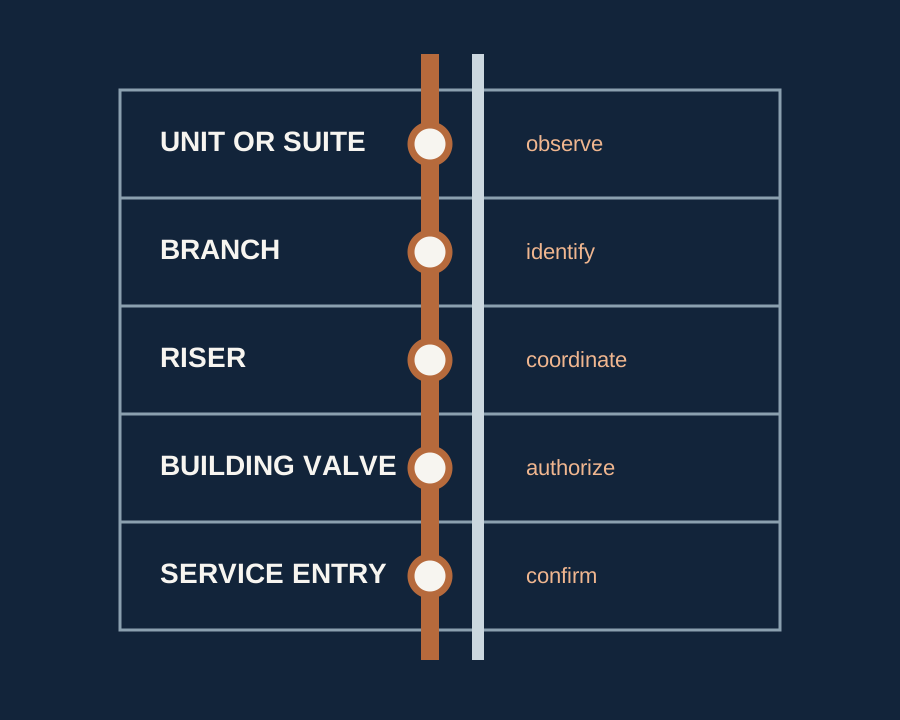
Most Financial District commercial buildings are managed by professional property management companies — Jones Lang LaSalle, CBRE, Colliers, or one of Boston's many regional property management firms — that serve as the primary point of contact for building maintenance decisions. These management companies have established protocols for authorizing repair work, managing vendor relationships, and documenting building maintenance activities for ownership reporting. Working effectively within these systems requires a specific type of professional maturity: the ability to communicate clearly in writing, provide detailed scopes of work in advance of pricing, deliver accurate time estimates for scheduling purposes, coordinate access with building security and tenant relations staff, and provide complete written documentation of work performed upon project completion. Financial District Plumbing Pros operates to these professional standards as a matter of course — we understand that in the commercial building management environment, our professionalism in communication and documentation is as important as our technical skill. We have established working relationships with many of the property management companies active in the Financial District and understand their specific authorization procedures and documentation requirements.
Commercial plumbing emergencies in the Financial District have stakes that residential emergencies do not: a failed water supply main in a 20-story office tower at 8 AM on a Monday can simultaneously disrupt the operations of dozens of tenants and require emergency response that involves building mechanical staff, the building management company, individual tenant facilities managers, and potentially the Boston Water and Sewer Commission — all while the plumbing contractor is working to isolate and repair the failure as quickly as possible. Handling this kind of multi-stakeholder emergency requires not just technical skill but the communication capability and professional composure to coordinate all of these parties efficiently under pressure. Our 24/7 emergency team is trained for commercial building emergency response — understanding who to notify, how to document the emergency for insurance purposes, how to prioritize restoration of minimum necessary service while permanent repairs are being arranged, and how to communicate clearly with building management about timeline and scope throughout the event. This level of commercial emergency competence is what distinguishes a true commercial plumbing contractor from a residential plumber who happens to take commercial calls.
The luxury loft condominiums occupying converted office buildings throughout the Financial District present a unique residential plumbing challenge: these are residential spaces with commercial-building infrastructure. The original building drain and supply systems were designed for commercial occupancy with different flow patterns, different fixture densities, and different hot water demand profiles than residential use. When a former accounting firm's floor is converted to a luxury residential loft, the existing drain rough-in locations may bear no relationship to where the residential kitchen and bathrooms need to be, requiring drain relocation through slab penetrations and new horizontal drain routing. Supply line pressures designed for commercial use may be either inadequate (if the original commercial system was not engineered to residential fixture standards) or excessive (creating water hammer and premature fixture wear in the new residential installation) without pressure-regulating valve adjustment. We perform the complete plumbing scope for Financial District loft conversion projects — from initial infrastructure assessment through final fixture trim-out — with the precision and coordination required for these sophisticated projects.
The Financial District's location at the center of Boston's most heavily developed urban core means that any project touching city utilities must navigate a regulatory landscape of considerable complexity. The Boston Water and Sewer Commission's infrastructure maps of 02110 show a network of water mains, sewer collectors, and utility tunnels that have been built and rebuilt across 150 years of downtown Boston development — and the current condition, configuration, and ownership of specific infrastructure segments is not always obvious from the maps alone. We have the BWSC regulatory experience to correctly identify permit requirements for any Financial District project, to navigate the BWSC's application and inspection process efficiently, and to coordinate with the utility location and excavation permitting systems required for any work involving street-level access to underground infrastructure. This expertise is particularly valuable for large-scale Financial District building projects — base building upgrades, tenant fit-outs with major plumbing components, or emergency sewer lateral repairs — where regulatory delay can significantly impact project cost and schedule.
High-rise commercial and residential buildings in the Financial District face a fundamental physics challenge: the water pressure available from the city main at street level — typically 40-80 PSI in the Financial District's distribution zone — is insufficient to supply water to upper floors of tall buildings without mechanical augmentation. In buildings taller than about 6-7 stories, a booster pump system must take the city supply pressure and boost it to the pressure required to deliver adequate flow at the highest fixture in the building. Most high-rise buildings use a staged approach: a master booster pump raises pressure to an intermediate level for a lower zone of floors, with secondary booster pumps serving successively higher zones up the building. Floor-by-floor or zone-by-zone pressure-reducing valves then step the pressure back down to fixture-safe levels at each floor, ensuring that the structural pressure at the valve is not destructively high. Failures in any element of this pressure management system — a failed booster pump, a stuck-open pressure-reducing valve, a failed pressure-relief valve on the booster discharge — can simultaneously affect multiple floors or the entire building. We service, repair, and replace all components of high-rise pressure management systems, from booster pump motor and impeller service to pressure-reducing valve cartridge replacement to expansion tank recharging.
The Financial District's ongoing wave of office-to-residential conversions — as the glut of Class B and C office space created by post-COVID remote work patterns drives building owners to seek alternative uses for underoccupied buildings — creates a new generation of plumbing conversion challenges that will define much of the district's maintenance work over the coming decade. Original commercial building drain systems routed floor drains and fixture connections to match the regular column and partition grid of an open office floor plate; converting that floor to residential apartments requires new bathroom and kitchen drain rough-in at locations that may be far from the existing drain connection points. Original commercial hot water systems sized for small point-of-use under-sink heaters in break rooms must be replaced with full-unit hot water heating capable of supplying residential showers, laundry connections, and dishwashers. Original plumbing chases sized for commercial lavatory connections must be adapted to carry residential supply and drain lines for apartment fixtures. We have completed the plumbing scope for several Financial District office-to-residential conversions and understand the unique challenges these projects present at every stage from feasibility assessment through construction administration to final punch-list completion.
Financial District office buildings typically house multiple commercial tenants on each floor, with shared building infrastructure — water supply mains, drain stacks, restroom cores — serving all tenants simultaneously. When a plumbing problem occurs in the shared infrastructure, its resolution must be coordinated with all affected tenants, who may have different operating schedules, different tolerance for service interruptions, and different lease provisions governing their rights during maintenance activities. A repair that requires shutting down a supply main for a building floor during business hours affects every tenant on that floor — law firms with client meetings, financial services firms with trading operations, corporate offices with global videoconferences — all of which must be notified, accommodated, and potentially compensated for disruption under their lease terms. We understand these dynamics and work with building management to plan, communicate, and execute multi-tenant building plumbing repairs in the way that minimizes operational impact while achieving timely, complete resolution of the plumbing problem.
The Financial District's oldest and most architecturally significant commercial buildings — the granite-clad bank buildings on State Street and the early 20th-century masonry commercial blocks on Franklin and Milk Streets — contain building fabric that deserves the same careful treatment as the historic residential buildings of Beacon Hill or the North End. Original terrazzo floors, ornate marble lobby finishes, decorative plaster ceilings in banking halls, and original tile work in executive washrooms are elements that building owners are increasingly choosing to preserve and restore as the district's older buildings compete for tenants on character rather than efficiency. Plumbing work in these buildings must be planned with sensitivity to the historic fabric, using access points and pipe routing strategies that minimize impact on irreplaceable original materials. We bring the same minimal-invasive approach to historic commercial buildings that we apply throughout Boston's historic residential neighborhoods.
From the granite canyons of State Street to the glass towers of Congress Street, and from the luxury lofts of the International Place complex to the historic office blocks of Franklin Street — Financial District Plumbing Pros serves all of ZIP 02110 and the surrounding downtown Boston neighborhoods. Our service area encompasses the complete Financial District, Downtown Crossing, the Leather District, Government Center, and the adjacent neighborhoods of Beacon Hill, the North End, South Boston, the South End, Back Bay, and Chinatown.
"We had a failed pressure-reducing valve on the 18th floor of our State Street office building that was sending excessive pressure to all fixtures on floors 16-20. Financial District Plumbing Pros diagnosed the problem, provided a clear scope and cost, coordinated the PRV replacement with minimal tenant disruption, and documented everything for our insurance records. Professional at every step."
"I converted a former law firm suite on Congress Street into a 3,200 square foot luxury loft. Financial District Plumbing Pros handled the entire plumbing scope — drain relocation through the slab, new copper supply distribution, tankless water heater installation, and all fixture trim-out. They coordinated seamlessly with my GC and met every milestone on the construction schedule. Outstanding work."
"We had a water main leak in the basement mechanical room of our Franklin Street building at 11 PM on a Wednesday. The building had lost water service to 8 office tenants who were working late. Financial District Plumbing Pros had a technician on-site within 35 minutes, isolated the leak, made the repair, and restored service before 1 AM. They also provided the insurance documentation we needed within 24 hours."
"Our restaurant in the International Place complex had a grease backup on a Friday afternoon that threatened our entire dinner service. Financial District Plumbing Pros arrived in 30 minutes, cleared the main kitchen drain line with commercial hydro-jetting equipment, and had us fully operational before 5 PM. They also assessed our grease interceptor and gave us a maintenance schedule to prevent recurrence. Invaluable service."
"We engaged Financial District Plumbing Pros for our BWSC-permitted lead service pipe replacement on our pre-war Milk Street building. They managed every aspect of the project — permit, street excavation coordination, Dig Safe notification, copper service installation, BWSC inspection, and sidewalk restoration. Clean, professional, on-schedule. They also replaced our ancient curb stop valve while the excavation was open — smart thinking that saved us from a future emergency."
High-rise commercial and residential buildings in Boston's Financial District experience a specific set of plumbing problems that reflect both the age and complexity of these buildings' mechanical systems. The most frequent issues we address in Financial District high-rises fall into four categories. First, pressure management failures: pressure-reducing valves in high-rise buildings cycle continuously under high pressure differentials and eventually develop cartridge wear that causes them to either pass excessive pressure downstream (damaging fixtures and creating water hammer) or restrict pressure below the minimum required for adequate flow at fixtures. Floor-group PRV stations typically need cartridge inspection every 3-5 years in a busy commercial building. Second, booster pump system failures: the motor, impeller, pressure sensors, and control electronics of commercial booster pump systems can fail independently, and when they do the results range from reduced pressure on upper floors (nuisance level) to complete loss of supply (emergency level). We maintain service agreements for booster pump systems in several Financial District buildings, providing scheduled maintenance and priority emergency response. Third, commercial restroom maintenance: high-use commercial restrooms in office buildings experience wear rates on flush valves, supply stops, and drain connections that are dramatically higher than residential use — a commercial flushometer valve serving 20-50 uses per day in a busy office restroom may need rebuild or replacement every 2-3 years, compared to a residential toilet fill valve that may last a decade. Fourth, drain system management in mixed-use buildings: buildings with restaurant or food service tenants on ground floors develop grease accumulation in shared drain stacks over time, eventually affecting the drain performance of commercial or residential tenants on upper floors. Regular drain camera inspection and preventive hydro-jetting keeps these systems performing properly. We offer comprehensive building plumbing maintenance programs for Financial District property management companies that address all of these issues proactively.
Plumbing maintenance in an occupied Financial District office building requires a level of logistical sophistication that goes well beyond simply scheduling a repair appointment. The process begins with a formal pre-work notification to the building management company at least 48-72 hours in advance for planned work (emergencies obviously require different handling), documenting the scope of work, the specific building systems affected, the duration of any service interruptions required, and the access requirements for each work area. This notification is then communicated by the property manager to the affected tenants, who may have scheduling requirements or concerns that need to be accommodated — a law firm cannot have its attorneys locked out of their restrooms during a board meeting, and a financial services firm's trading floor cannot tolerate supply system shut-down during market hours. For work requiring supply system shutdown affecting multiple tenants, we provide shutoff timing windows that typically occur before 8 AM or after 6 PM on business days, or on weekends when the building is largely unoccupied. During all work periods, we maintain building security protocols — signing in with the building's security desk, wearing our company identification prominently, and following established visitor management procedures. Our written scope of work and pricing proposals are formatted for building management company review, including clear identification of work that is included in the base price versus items that are unit-priced and may vary based on actual conditions. Upon work completion, we provide written documentation of work performed, materials used, and any observations about adjacent building systems that may warrant attention — this documentation supports the building owner's maintenance records and helps property managers answer tenant inquiries about work history accurately.
Luxury loft condominiums in converted Financial District office buildings present residential plumbing challenges that are fundamentally shaped by the original commercial building context in which they exist. Unlike purpose-built residential buildings where drain and supply rough-in locations were chosen by the architect to serve residential floor plans, converted loft condos have drain connections and supply stub-outs at locations that served the original commercial use — which may be quite different from where the residential kitchen, master bathroom, and secondary bathrooms need to be in the loft's floor plan. Moving drain connections in a concrete slab construction building (common in Financial District commercial buildings) requires saw-cutting and coring the existing slab to create new drain penetrations — a structurally significant operation that requires structural engineer consultation and building management approval for each new penetration. Supply connections in high-rise buildings require careful consideration of floor-level pressure-reducing valve settings to ensure that residential fixture requirements are met without exceeding the pressure ratings of residential fittings and appliances. Many Financial District loft conversions also involve unusually high water heater demands — enormous soaking tubs, multi-head shower systems, and radiant floor heating in luxury finishes — that exceed the output of standard residential water heating equipment and require commercial-grade or tankless high-output solutions. We perform comprehensive loft plumbing assessments before finalizing scope and pricing for conversion projects, identifying all of these factors in advance rather than discovering them mid-project. Our experience with multiple Financial District loft conversions means we have encountered and solved most of the common challenges specific to this building type, and we approach each new project with a body of institutional knowledge that reduces surprises and improves execution quality.
Commercial buildings in the Financial District are subject to the Boston Water and Sewer Commission's Cross-Connection Control Program, which requires approved backflow prevention devices on water service connections where a cross-connection risk exists between the building's internal plumbing system and the public water supply. The type of backflow prevention device required depends on the degree of hazard posed by the building's internal plumbing: a standard office building with only lavatory fixtures and drinking fountains may require only a double-check valve assembly at the service entry; a building with process water systems, cooling towers, fire suppression systems with chemical additives, or other high-hazard uses will require a reduced-pressure zone (RPZ) assembly at the service entry, with additional device protection at individual cross-connection points within the building. BWSC requires annual testing and certification of all registered backflow prevention devices by a licensed tester, with the test results submitted to BWSC as proof of device functionality. Failure to maintain required devices and submit annual test reports can result in BWSC service shutoff — a serious operational consequence for a commercial building. We install, maintain, test, and certify backflow prevention assemblies for Financial District commercial buildings, providing the annual test reports required by BWSC and maintaining test records in our client files for easy retrieval when BWSC requests documentation. For building owners planning major renovations or change-of-use conversions, we assess the backflow prevention requirements of the new use configuration and advise on any device upgrades or additions required by BWSC regulations for the planned building use.
Plumbing emergencies during Financial District business hours require a specific response approach that balances rapid technical intervention with the professional communication and documentation demands of a commercial property management environment. When we receive an emergency call from a Financial District building, our dispatcher immediately gathers the key information: the building address, the nature of the emergency, whether water is actively flowing and causing damage, whether the main supply has been isolated or can be isolated, who has building management authorization to approve the repair scope, and what the access situation is for our service vehicle. Our dispatch protocol for Financial District emergencies routes the call to the nearest available licensed commercial plumber with the equipment necessary for the specific type of emergency, and simultaneously generates a digital work order that begins documenting the incident timeline for insurance purposes. When our technician arrives, the first priority is life safety and damage limitation — isolating the water source if it has not already been done, dewatering if flooding has occurred, and assessing the extent of damage. The second priority is diagnosis and a clear scope of work presented to the building management contact for authorization before any repair work begins. We do not proceed with repair work on commercial properties without explicit authorization from an appropriate building authority — this protects both the building owner and our own liability exposure in a commercial property context. For genuine emergencies where damage is ongoing and authorized staff cannot be reached immediately, we take the minimum necessary protective action (isolating the water source) and document that action, then complete full authorization before beginning the repair itself. This approach is different from residential emergency response, where the homeowner on-site typically has immediate authority to approve all needed work — commercial building authorization protocols require a more structured approach that our team is trained to navigate efficiently.
Water quality in Financial District buildings reflects both the characteristics of the MWRA's treated supply and the condition of the building's internal plumbing infrastructure. The MWRA's water is treated with chloramine as the disinfection agent — which means it has a persistent chemical taste and odor that many office workers and residents find objectionable, and which requires catalytic carbon filtration (not standard activated carbon) for effective removal at point-of-use. For luxury loft residents who care about the quality of their drinking and cooking water, properly specified under-sink or whole-unit filtration is a meaningful quality-of-life investment. For Financial District pre-war buildings, the lead service pipe issue is identical to that facing other historic Boston neighborhoods: buildings constructed before the late 1940s may have original lead service pipes connecting the city main to the building's water distribution system. We have replaced lead service pipes in several Financial District pre-war commercial and mixed-use buildings under BWSC permit, and we provide point-of-use NSF/ANSI 53-certified lead reduction filtration for building occupants in buildings awaiting lead service replacement. For commercial buildings with cooling towers, the water treatment in those systems raises additional water quality concerns — Legionella bacteria control programs are required for cooling tower systems in Boston, and water treatment for these systems must be managed by licensed water treatment contractors in coordination with the building's plumbing contractor. We can coordinate with water treatment specialists on cooling tower system maintenance when building management requires this integration with building plumbing service work.
Yes — booster pump system service and maintenance is a core capability of our Financial District commercial plumbing practice. High-rise domestic water booster pump systems are complex mechanical assemblies that integrate multistage centrifugal pumps, motor starters and variable frequency drives (VFDs), pressure transducers and controllers, expansion tanks, and pressure relief valve assemblies — all working together to maintain stable supply pressure in buildings where the city main pressure alone is insufficient. We service all major commercial booster pump brands including Bell & Gossett, Grundfos, Armstrong, and Xylem, and we maintain service agreements with several Financial District buildings that include scheduled quarterly inspections of the booster system, VFD programming verification, pressure sensor calibration, expansion tank pressure checks, and mechanical inspection of pump components. Emergency booster pump service — for situations where a pump failure has caused loss of water pressure in upper building floors — is available 24/7 with typical response times of 35-60 minutes in the Financial District. For emergency booster pump failures, our priority is restoring minimum supply pressure to the upper floors as quickly as possible, which may involve bypassing a failed pump in a duplex or triplex system to allow the remaining pumps to carry the building load while the failed unit is repaired or replaced. For pump replacement projects — where a booster pump or complete booster system has reached end of life — we provide complete project management including equipment specification, permit application, installation coordination with building operations, and commissioning testing to verify that the new system meets the building's pressure requirements at all floors and all flow conditions.
We offer structured plumbing maintenance programs for Financial District commercial buildings that provide property management companies with predictable, comprehensive plumbing maintenance coverage across the complete building plumbing system. Our standard commercial building maintenance program includes annual full-building plumbing inspection (covering all accessible supply, drain, and mechanical plumbing components), semi-annual drain camera inspection of main building stacks and sewer lateral, quarterly booster pump system inspection (for buildings with booster systems), annual backflow prevention device testing and BWSC certification report submission, and priority emergency response with guaranteed 45-minute maximum response time for covered buildings. The program is priced on a flat annual fee based on building size and system complexity, and it replaces the unpredictable expense of reactive-only plumbing maintenance with a structured, budgetable approach that typically costs significantly less in total than unplanned emergency work while also reducing the risk of major building-wide failures that result from deferred maintenance. For property management companies managing multiple Financial District properties, we offer portfolio-level maintenance programs with consolidated billing and consistent service standards across all covered properties. Buildings enrolled in our maintenance program receive priority scheduling for non-emergency work, discounted rates on repair work outside the maintenance scope, and proactive notification of developing issues identified during routine inspections before they become emergencies. Building owners consistently find that the documentation generated by a structured maintenance program — the inspection reports, camera inspection records, and maintenance history logs — significantly enhances the building's due diligence profile when the property is being refinanced or sold.
From the granite banking halls of State Street to the luxury lofts above Congress Street — Financial District Plumbing Pros delivers the professional plumbing service that Boston's business and residential center deserves. Call now for immediate service.
Call (888) 861-3658 Now (888) 861-3658Available 24/7 • MA Licensed Plumber • Financial District & Downtown Boston 02110